Betting the $12M Farm, Part One: The Terms
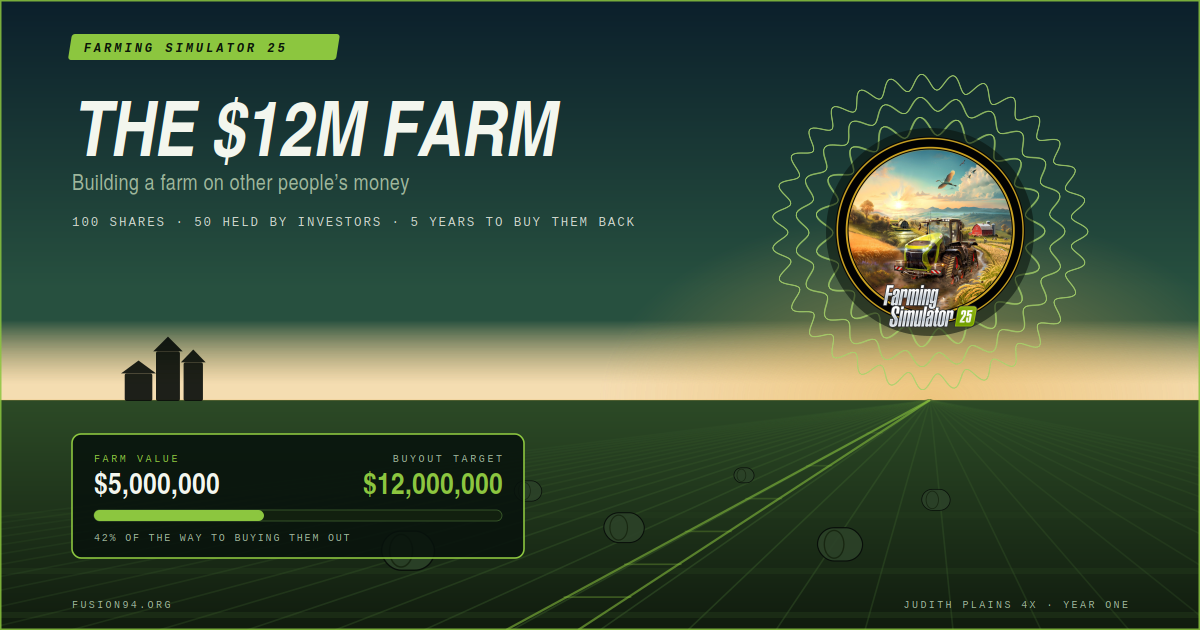
I’m building a farm on Judith Plains, Montana, from nothing — $1M of my own money and $4M raised from investors who hold half the shares. They paid $80,000 a share against $50,000 of book value, and buying them out after year five costs at least $120,000 each. The farm has to reach $12M.
| Day | 1 of 84 |
| Cash | $5,000,000 |
| Farm value | $5,000,000 |
| Share price | $50,000 |
| My ownership | 50% |
| Distance to $12M | $7,000,000 |
There are no investors. That is the only fictional thing about this.
Everything else — the cap table, the dividend schedule, the dilution clause, the loss carryforward rules — is real in the only sense that matters, which is that I have written it down in advance and I am not allowed to change it when it becomes inconvenient. The investors are imaginary. The obligation to them is not.
Here’s the setup. I’m playing Farming Simulator 25 on Judith Plains, a 4X Montana map, with seven-day months. That gives an 84-day year, five of which I’ve committed to. I started with a million dollars of my own capital and raised four million more against a hundred shares of a farm that did not exist yet.
The cap table
| My capital | $1,000,000 |
| Outside raise | $4,000,000 |
| Total | $5,000,000 |
| Shares outstanding | 100 |
| My stake | 50 |
| Investor stake | 50 |
| Book value at open | $50,000/share |
| What investors paid | $80,000/share |
| Premium to book | 1.6x |
That premium is the whole game. My investors paid sixty percent over book for a farm with no land, no crops, and no animals, and the only way that ever becomes a good decision for them is if I grow into it.
I originally wanted the premium to be 2x, which is what you’d get if the raise were the entire farm value. But the arithmetic doesn’t allow it once you contribute your own money. With a fifty-fifty split, the premium works out to twice the raise divided by total capital — two times four over five, or 1.6. To hit a clean 2x I’d have to take a sixty-forty split in my own favour, which would hand me control and soften the entire premise. So: 1.6x, fifty-fifty, and I say the real number out loud rather than the flattering one.
They can be bought out after year five, at whatever a share is worth then, with a floor of $120,000 so they can’t lose. Fifty shares at the floor is six million dollars. For the market price to actually reach that floor rather than the floor being a penalty I’m eating, the farm has to be worth twelve million.
Twelve million, from five, in five years, while paying out a dividend every single one of them. That’s the target. Everything I do for the next 420 in-game days gets measured against it.
The dividend
Fifty percent of profit is distributed annually, pro-rata across all shares. I hold half, so twenty-five percent of profit leaves the farm and twenty-five percent comes back to me as retained cash. My real burden is a quarter of profit, and I’d rather say that plainly than let anyone assume I’m under a harsher load than I am.
Two clauses make it bite.
Capital purchases don’t shelter profit. Buildings, vehicles, land, and placeables are not expenses for dividend purposes. Buy a two-hundred-thousand-dollar forage harvester in a good year and you still owe the full dividend on the profit that bought it. I can’t reinvest my way out of an obligation. The one exception is livestock — animals count as an expense, because a series about livestock that punishes you for buying livestock isn’t a series, it’s a sulk.
Missing a dividend dilutes me. If I can’t pay, the shortfall converts to new investor shares issued at current book value. Three things then happen at once: total shares rise so every share is worth less, my ownership drops below fifty percent so a larger slice of every future distribution walks out the door instead of returning to me, and the buyback gets more expensive because there’s more to buy back. It’s a genuine death spiral and it needs no adjudication from me. The arithmetic does it.
That’s why the standing table at the top of every post in this series shows my ownership percentage. The day it reads anything other than 50%, you’ll know exactly what happened before I’ve written a word about it.
The rules
- Eighty percent of every harvest goes to feed. No more than a fifth can be sold as raw crop.
- Three contracts a month, and I have to own the equipment. No leasing, and no hired workers on contract jobs.
- Borrowing is for land only. Never equipment, never livestock, never to cover a dividend. Two million cap, variable rate.
- Debt is subtracted from farm value. Otherwise I could inflate my own share price by taking out a loan, which is precisely the kind of thing this series exists to notice.
- Losses carry forward three years, capped at half of any single year’s profit. So a profitable year always pays something.
- Payroll stays under fifteen percent of gross. This also decides whether I approve a raise request.
- No selling breeding stock to cover a dividend. No field flipping. No liquidating assets to paper over a bad year.
Selling starter equipment to fund equipment I actually need is a reallocation and it’s allowed. Selling things because I’m short is not.
What I’m actually building
Not a grain operation. Cows, sheep, chickens, and pigs, plus a rice greenhouse and a honey collection.
That combination is deliberate. Every farming series I’ve watched has the same shape — plant in spring, sweat through summer, get paid at harvest, then fast-forward through a dead winter. Milk, eggs, wool, honey, and greenhouse output don’t care what month it is. My income never stops, which means my obligations never stop either, and a dividend that comes due in a year the crop failed is a much more interesting problem than one that doesn’t.
The eighty percent feed rule is what ties it together. It means the fields exist to serve the barns. Crop sales stop being revenue and become a rounding error, and the binding constraint on how many animals I can keep becomes how much ground I can grow feed on. Every expansion decision turns into an acreage question, which is a far better recurring story than “can I afford the building.”
There’s a wrinkle I only spotted while working through it. Grass, hay, and silage are exempt from the eighty percent count — they’re feed by definition, so counting them would satisfy the rule automatically and make it meaningless. Which means sheep and cows barely touch my harvest ledger and pigs and chickens eat straight out of it. The dairy herd is the cheap thing to scale. The pigs will hit a feed wall long before they hit the barn’s capacity.
Day one
The starter farm came with a fleet: a John Deere S7 with both headers, two 6R tractors, a Horsch planter, a Kuhn drill, a SaMASZ butterfly mower, a Fliegl slurry tanker, a Volvo semi, and a dozen other things. Two million two hundred and twenty-six thousand four hundred and fifty dollars’ worth, all of it pre-worn — the 6R Extra Large has 888 hours on it.
I paid for all of it.
That matters more than it sounds. Farm value counts vehicles, so if two and a quarter million dollars of machinery had simply arrived free, my book value would have jumped from fifty thousand a share to seventy-three thousand overnight — and my investors, who paid eighty, would have captured almost the entire premium on day one without me having farmed a single hectare. The premium exists so I have to grow into it. So the valuation gets struck at the close of the raise, before anything is bought, and everything on this property is paid for out of the five million.
A purchase at fair market value is neutral. Cash goes down, assets go up, farm value doesn’t move. Only free things distort the books.
So: five million in, the farm and the fleet bought, and the balance sheet still reads exactly five million dollars. Fifty thousand a share. My investors are underwater by sixty percent and will be for some time.
Then I sold the Volvo and the hopper trailer, at a loss, because they were worn — and because a truck that exists to haul grain to market is dead capital on a farm that has forbidden itself from selling grain. My own rule made a two-hundred-thousand-dollar asset redundant inside an hour. It’s paying for the forage harvester I need instead.
What happens next
Water. Nothing in that entire two-million-dollar fleet carries any, and four species plus a greenhouse drink every day for eighty-four days.
After that, chickens — the cheapest revenue I can buy — and then an argument about why I’m spending money on a baler before I own anything that eats hay.
I’ll publish a full budget reconciliation every quarter and a complete valuation at year end: profit, dividend, share price, ownership, and the distance still left to twelve million. The spreadsheet is the real protagonist here. The tractors are just how the numbers move.
Series icon by NC831, used under its non-commercial terms.