Four Texas Gun Bills Prefiled for 2027: What They Actually Say
Four Texas Gun Bills Prefiled for 2027: What They Actually Say
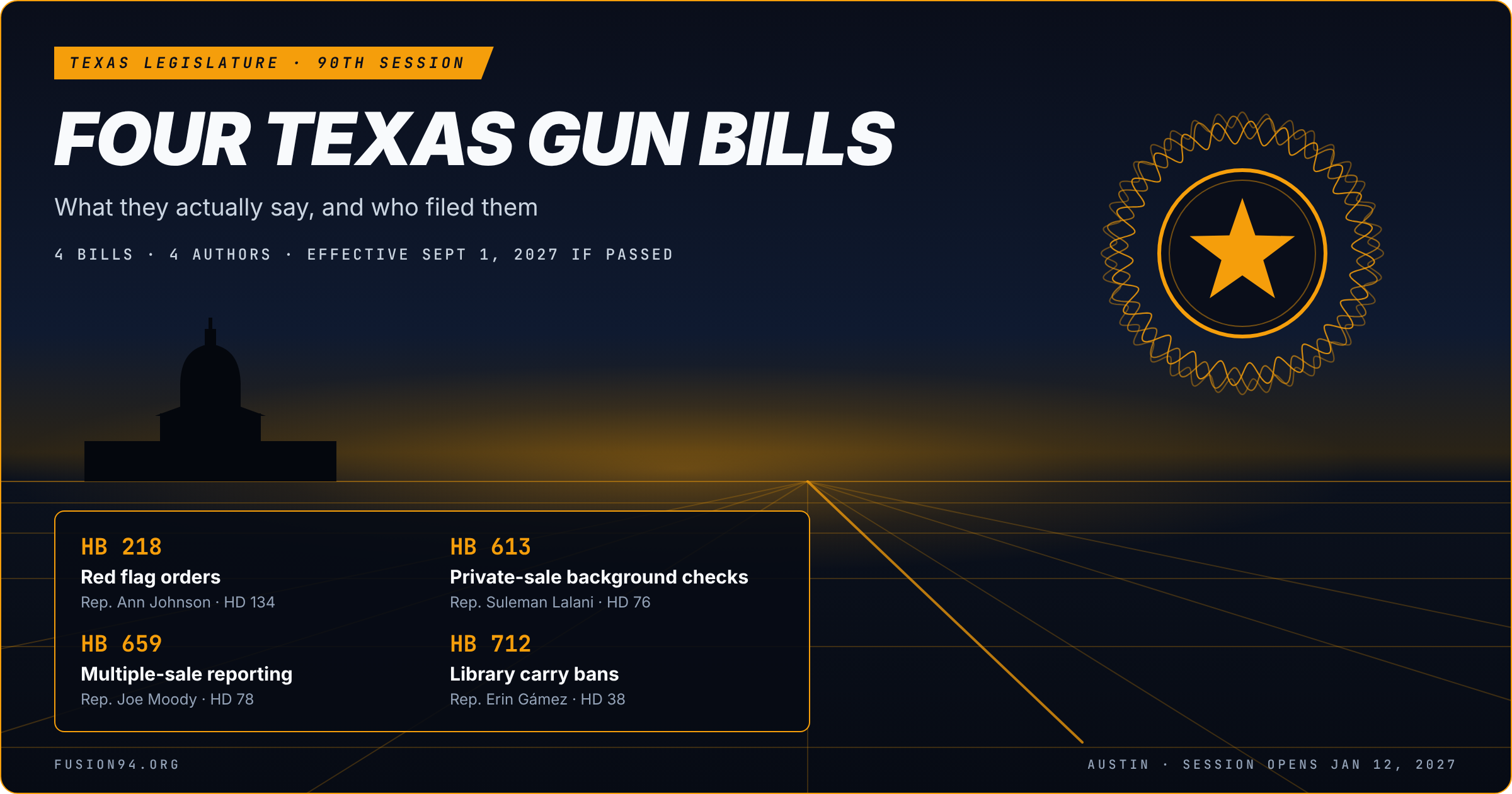
Prefiling for the 90th Texas Legislature is underway. The session convenes January 12, 2027 and runs through May 31. Among the early filings are four House bills that would change how Texans buy, sell, carry, and in some cases give up firearms. All four come from Democratic members. After the November 3 election, these bills now have a better chance than in past sessions.
I read the bill text of all four. Here’s what each one does, who filed it, and what to watch for.
| Bill | Author | Subject | Top penalty |
|---|---|---|---|
| HB 218 | Rep. Ann Johnson (D–Houston, HD 134) | Extreme risk protective orders (“red flag”) | Class A misdemeanor |
| HB 613 | Rep. Suleman Lalani (D–Sugar Land, HD 76) | Background checks on private sales | Class A misdemeanor |
| HB 659 | Rep. Joe Moody (D–El Paso, HD 78) | Dealer reporting of multiple gun/magazine sales | Class B misdemeanor |
| HB 712 | Rep. Erin Gámez (D–Brownsville, HD 38) | Local authority to ban guns in public libraries | Set by local rule |
All four would take effect September 1, 2027 if passed.
The political backdrop
The 2025 session didn’t pass bills like these. Lalani filed a nearly identical universal background check bill (HB 397), Johnson filed a red flag bill (HB 234), and Moody filed his own red flag bill (HB 893). None got out of committee. The Legislature went the other way instead and passed SB 1362, the “Anti-Red Flag Act.” It bars state and local entities from enforcing extreme risk protective orders unless Texas law authorizes them, and it makes enforcing an out-of-state red flag order a state jail felony.
The 2026 election changed that. Democrats won a majority in the Texas House for the first time since the 2002 election, and they won the governor’s and lieutenant governor’s offices. Republicans kept a majority in the Texas Senate, though a Democratic lieutenant governor will now preside over it and control its agenda.
In practice, these bills are likely to get House committee hearings and possibly floor votes. To become law they would still have to pass a Republican-majority Senate.
HB 613: Background checks on private sales
Author: Rep. Suleman Lalani (D–Sugar Land), a physician who has represented House District 76 in Fort Bend County since 2023.
What it does
HB 613 adds a new Chapter 205 to the Business & Commerce Code. Under it, nobody may sell or otherwise transfer a firearm unless:
- the seller is a federally licensed firearms dealer (FFL);
- the buyer is an FFL; or
- before handing over the gun, the private seller has an FFL run a National Instant Criminal Background Check System (NICS) check “in the manner required by 18 U.S.C. §922,” and confirms the buyer can legally possess a firearm.
The dealer runs the check, tells the seller the result, and may charge a “reasonable fee.” The bill doesn’t cap or define that fee.
Penalty: A violation is a Class A misdemeanor, punishable by up to one year in county jail and a fine of up to $4,000.
What to watch
- There are no exemptions. The bill doesn’t define “otherwise transfer,” and it has no carve-outs for gifts between family members, inheritance, loaning a rifle on a hunting trip, letting someone try a gun at the range, or a temporary transfer to someone in danger. Most states with universal background check laws write in those exceptions. As drafted, HB 613 would appear to cover all of them.
- How the check would work is unclear. Private citizens can’t access NICS. Under federal practice, a dealer usually runs a check by taking the gun into inventory and having the buyer fill out ATF Form 4473. The bill says the check has to be done “as required by §922” but doesn’t say how that works for a sale the dealer isn’t part of.
HB 659: Reporting multiple sales of guns and magazines
Author: Rep. Joe Moody (D–El Paso), an attorney and one of the longest-serving Democrats in the House. He represents House District 78 and sits on the Criminal Jurisprudence and Judiciary committees.
What it does
Licensed dealers would have to report to the Texas Department of Public Safety (DPS) when a single non-dealer buyer gets either of the following within five consecutive business days:
- two or more firearms of any type, rifles and shotguns included; or
- four or more detachable magazines. Magazines that come in the factory box with a new gun don’t count.
Before every gun or magazine sale, the dealer has to check that buyer’s recent purchase history to see whether the sale triggers a report.
The report goes on a DPS form and includes:
- dates and locations of the sales
- the type and number of firearms or magazines
- the dealer’s identity and location
- the buyer’s identity
- a copy of the buyer’s ID
Within 24 hours, DPS forwards the report to the sheriff of every county where a sale happened and the sheriff of the buyer’s home county.
Confidentiality and the registry question
Reports are confidential and exempt from the Texas Public Information Act. The bill says they can’t be used to build “a registry or other database” of gun owners, guns, or magazines. That rule has an exception: the information may go into NICS, the Texas Crime Information Center (TCIC), and the National Crime Information Center (NCIC).
Penalty: A dealer who violates the law through criminal negligence commits a Class B misdemeanor, punishable by up to 180 days and a fine of up to $2,000. The bill doesn’t penalize buyers.
What to watch
Federal law already requires FFLs to report multiple handgun sales within five business days to ATF and local law enforcement on ATF Form 3310.4. Texas dealers also report certain multiple semi-automatic rifle sales under a federal rule that covers border states. HB 659 adds three things:
- coverage of all long guns, not just handguns and certain rifles;
- coverage of magazines, which no federal rule tracks; and
- a parallel state reporting system that notifies two sheriffs.
The anti-registry language is there, but sending the reports into TCIC and NCIC means the information will be stored somewhere.
HB 712: Letting cities and counties ban guns at public libraries
Author: Rep. Erin Gámez (D–Brownsville), an attorney who has represented House District 38 in Cameron County since a 2022 special election. In 2023 she was one of the House’s twelve impeachment managers in the trial of Attorney General Ken Paxton.
What it does
Texas has strong preemption laws. Local Government Code §229.001 (cities) and §236.002 (counties) generally bar local governments from regulating firearms. HB 712 adds a new exception to both: a city or county could regulate or prohibit carrying firearms on the premises of a library it established and operates.
Under the bill, these people could still carry in a library:
- peace officers and others covered by Penal Code §46.15(a)(1), such as officers and special investigators;
- on-duty military, National Guard, and similar personnel covered by §46.15(b)(1); and
- people licensed or commissioned under Occupations Code Chapter 1702, such as commissioned security officers and private investigators.
What to watch
- License to Carry holders and permitless carriers aren’t exempted. A library ban adopted under this bill would apply to them.
- It could conflict with existing law. HB 712 doesn’t amend Government Code §411.209, which penalizes political subdivisions that post signs barring LTC holders from places where state law allows them to carry. It also doesn’t add libraries to Penal Code §46.03’s list of prohibited places. A city adopting a ban could face the same kind of §411.209 challenge the Attorney General has brought against cities before. That conflict would probably end up in court unless the bill is amended.
- The scope is narrow. It covers only libraries a city or county established and operates. School district and college libraries aren’t included.
HB 218: Extreme risk protective orders (“red flag”)
Author: Rep. Ann Johnson (D–Houston), a former chief human trafficking prosecutor who has represented House District 134 since 2021. She won reelection on November 3.
At 15 pages, HB 218 is the longest and most detailed of the four bills.
Who can file
An application can come from:
- a member of the respondent’s family or household;
- the parent, guardian, or conservator of a minor in the respondent’s family or household; or
- a peace officer.
The application has to be sworn. It must include detailed allegations based on personal knowledge, any medical or mental health records available, and what the applicant believes about the type, quantity, and location of the respondent’s firearms.
The mental illness requirement
Unlike most states’ red flag laws, HB 218 requires a connection to mental illness. At every stage, the court has to find danger “as a result of the respondent’s serious mental illness and access to firearms.” The bill borrows the definition of serious mental illness from Insurance Code §1355.001, which covers conditions such as schizophrenia, bipolar disorder, and major depressive disorder. Most red flag laws in other states are based on dangerous behavior alone.
How the process works
| Stage | Legal standard | What can happen |
|---|---|---|
| Temporary ex parte order (no notice, no hearing) | “Reasonable cause” based on the application | Ban on buying or possessing guns; surrender guns to police within 24 hours; surrender LTC; court-ordered mental health exam |
| Full hearing (within 14 days, with personal notice) | Clear and convincing evidence | One-year order: gun ban, surrender of guns and LTC, LTC suspension, possible required outpatient treatment |
| Renewal | New hearing with notice | Up to one additional year |
| Motion to end the order early | Can be filed after day 91 | The order stays in place unless the court finds no continuing need, which puts the burden on the respondent |
At the full hearing, the judge must consider:
- the mental health exam results and any relevant medical history
- any history of threats or violence, including self-harm
- recent violations of other protective orders
- arrests or convictions for stalking or violent offenses, including family violence
- convictions for animal cruelty
- evidence of current or recent drug or alcohol abuse (past treatment or recovery can’t be counted against the respondent)
The judge may also consider recent purchases of guns, ammunition, or other deadly weapons.
Getting firearms back
HB 218 adds Article 18.192 to the Code of Criminal Procedure, which covers what happens to surrendered guns:
- Police must give a receipt and written instructions for getting the guns back.
- Once the order ends, police have 30 days to run a background check. If the person passes, they’re notified by certified mail and have 120 days to request their guns.
- Surrendered firearms can’t be destroyed or forfeited to the state. If they go unclaimed, or the person has since become prohibited, a licensed dealer sells them and the owner gets the proceeds minus administrative costs.
Other provisions
- Confidentiality: Medical and mental health information is removed from the public court record.
- NICS reporting: The court clerk sends the order to DPS within 24 hours, and DPS forwards it to the FBI for NICS within 24 hours.
- License to Carry: Being subject to an ERPO makes someone ineligible for an LTC, and an existing license is suspended for as long as the order lasts.
- New crimes:
- Buying, owning, or possessing a firearm after being notified of an ERPO: Class A misdemeanor.
- Knowingly lying to a peace officer to get them to seek an ERPO: Class B misdemeanor. False statements in a family member’s sworn application would fall under existing perjury law.
- Repeals the Anti-Red Flag Act. HB 218 repeals Code of Criminal Procedure Chapter 7C, which SB 1362 created in 2025. That makes it the most direct reversal of a recent law among these four bills.
The bottom line
| HB 613 | HB 659 | HB 712 | HB 218 | |
|---|---|---|---|---|
| Who it affects | Anyone transferring a gun privately | Dealers (and indirectly buyers of 2+ guns or 4+ magazines) | Carriers at city and county libraries | People found dangerous because of serious mental illness |
| Drafting issues | No family or temporary-transfer exceptions; unclear how dealers would run the check | Overlaps federal reporting; data goes into NCIC/TCIC | Conflicts with Gov’t Code §411.209 | Respondent bears the burden on early termination |
| Hardest hurdle | Republican-majority Senate | Republican-majority Senate | Preemption litigation | Reverses a 2025 law |
A drafting note: HB 613 and HB 659 both create a “Chapter 205” in the Business & Commerce Code. If both pass, one will be renumbered, which is routine.
Each bill stands on its own, so any one could pass without the others. With a Democratic House, gun legislation is likely to get more attention in 2027 than in recent sessions, and the Senate will decide whether any of these bills becomes law.
Sources
- Bill text: HB 218, HB 613, HB 659, HB 712 (90th Legislature, introduced versions) — Texas Legislature Online
- Texas Code of Criminal Procedure, Chapter 7C
- SB 1362 (89R) enrolled bill analysis
- NRA-ILA: 2025 Texas prefiled firearm legislation
- PBS NewsHour / AP: Democrats win full control of more state governments and the Texas House
- MultiState: Texas 2026 election results
- Author bios: Ann Johnson, Suleman Lalani, Joe Moody, Erin Gámez